How to prepare AGILUS®
A live demonstration on how to prepare AGILUS® ready for administration.
For UK Healthcare Professionals
Prescribing information and adverse events reporting information can be found at the bottom of the page


In combination with adequate support measures, AGILUS® (dantrolene sodium hemiheptahydrate) is indicated for the treatment of malignant hyperthermia in adults and children of all ages.
To reduce the risk of serious complications, the timely treatment of Malignant Hyperthermia is required. These complications include:
Adapted from Riazi S, et al. 2014.*
*Relationship between dantrolene administration time (interval between first clinical sign and first dose of dantrolene) measured in minutes and percentage of malignant hyperthermia complications from a series of 16 patients.

AGILUS® lets you give the same dose of dantrolene more rapidly, using smaller fluid volumes, and requiring fewer vials, than with DANTRIUM IV (dantrolene sodium).
Malignant hyperthermia (MH) is a life-threatening syndrome caused by sudden, uncontrolled skeletal muscle hypermetabolism in response to inhalational anaesthetics and depolarizing muscle relaxants.
During an MH crisis calcium channels are rapidly activated causing the release of substantial amounts of calcium ions, leading to muscle contraction and rigidity.

Complications after MH crisis occur in up to 30% of patients, including cardiac, renal, pulmonary and haematological disorders.

In the UK there are approximately 20 cases of MH every year.
A key component in the treatment of an MH reaction is dantrolene. This is to be administered as soon as possible after MH is suspected.
Dantrolene is a skeletal muscle relaxant that inhibits calcium release by antagonising the ryanodine receptor (RyR1).
Dantrolene depresses the intrinsic mechanisms of excitation–contraction coupling in skeletal muscle.
The introduction of dantrolene in 1979 contributed to a reduction in MH mortality from approximately 80% to 6-10%, and it remains a key therapy in treating a malignant hyperthermia crisis.
Delays in administration produce an increase in complication rates, with a time to treatment of over 50 minutes leading to 100% of patients experiencing complications in a study with 16 patients.
Compared to DANTRIUM IV, when used to treat MH, AGILUS® may lead to a reduction in:*

A laboratory non-clinical simulation study found that on average 120mg of AGILUS® (1 vial) can be reconstituted and administered in approximately 1 min 53s vs approximately 18 minutes for 120mg of DANTRIUM IV (6 vials) (assuming a single operator).*
AGILUS® allows more rapid treatment vs. DANTRIUM IV treatment in a time-critical MH emergency.

The volume of dantrolene solution administered is greatly reduced with AGILUS®.
To administer a 2.5 mg/kg dose to a 72kg patient requires a fluid volume of 540ml with DANTRIUM IV, but only 33.9ml with AGILUS®.

Less time spent on preparation may free up personnel to help manage other aspects of an MH crisis.
*Performed under simulation conditions, using a single operator in a controlled environment.
This study prepared AGILUS® by shaking until reconstituted, which took an average of 32s. AGILUS® summary of product characteristics states that the product should be shaken for 1 minute before being examined. Please see the summary of product characteristics for full preparation information.
| Dantrolene mg per vial | WFI* per vial | Time to prepare and administer 120mg** | Filter required | |
|---|---|---|---|---|
| DANTRIUM IV | 20 | 60 mL | 18 min 00 sec | Yes |
| AGILUS® | 120 | 20 mL | 1 min 53 sec | No |
To treat a 72kg patient with a 2.5mg/kg bolus dose of dantrolene, AGILUS® needs 1.5 vials and takes up to 3min 46sec to prepare and administer, compared to 9 vials and 27 minutes for DANTRIUM IV**
*Water for injections. **Performed under simulation conditions, using a single operator in a controlled environment.
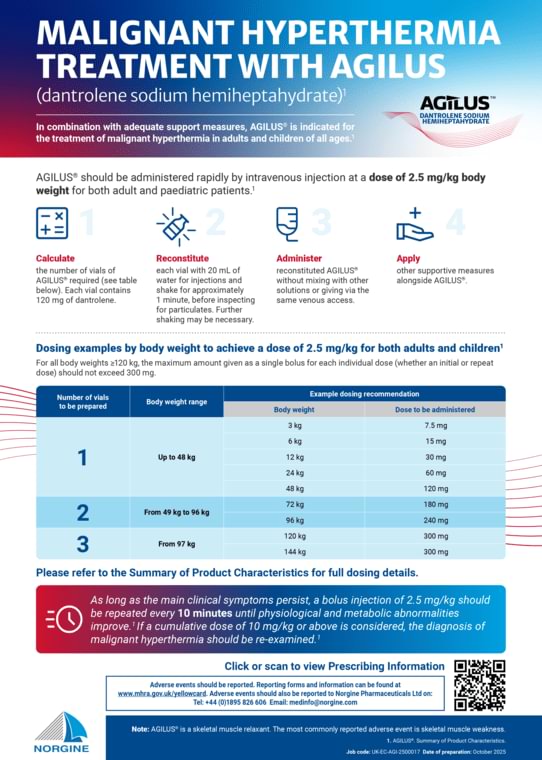
AGILUS® should be administered rapidly by intravenous injection at an initial dose of 2.5 mg/kg body weight for adult and paediatric patients.
A bolus injection of 2.5 mg/kg should be repeated every 10 minutes as long as the main clinical symptoms persist.
In the same patient, treatment with AGILUS® requires a lower number of vials compared to DANTRIUM IV.
For all bodyweights, the initial dose and any repeat doses should not exceed 300 mg, equivalent to 2.5 vials, per round of treatment.

| Number of vials of AGILUS® to be prepared1 | Body weight range | Example dosing recommendation | |
|---|---|---|---|
| Body weight | Dose to be administered | ||
| 1 | Up to 48 kg | 3 kg | 7.5 mg |
| 6 kg | 15 mg | ||
| 12 kg | 30 mg | ||
| 24 kg | 60 mg | ||
| 48 kg | 120 mg | ||
| 2 | From 49 kg to 96 kg | 72 kg | 180 mg |
| 96 kg | 240 mg | ||
| 3 | From 97 kg | 120 kg | 300 mg |
| 144 kga | 300 mga | ||
aFor all bodyweights, the initial dose and any repeat doses should not exceed 300 mg, equivalent to 2.5 vials.
The European Malignant Hyperthermia Group guidelines
Dantrolene is on the European Medicine Agency (EMA) list of critical medicines.
The Phase 1 study of AGILUS® demonstrated:*
Pre-clinical safety assessments for AGILUS® showed:
| System organ class | Frequency | Adverse drug reactions |
|---|---|---|
| Immune system disorders | Not known | Hypersensitivity, Anaphylactic reaction |
| Metabolism and nutrition disordersa | Not known | Hyperkalaemia |
| Nervous system disorders | Not known | Dizziness, Somnolence, Seizure, Dysarthria, Headache |
| Eye disorders | Not known | Visual impairment |
| Cardiac disordersa | Not known | Cardiac failure, Bradycardia, Tachycardia |
| Vascular disorders | Not known | Thrombophlebitis |
| Respiratory, thoracic and mediastinal disorders | Not known | Respiratory failure, Respiratory depression |
| Gastrointestinal disorders | Not known | Abdominal pain, Nausea, Vomiting, Gastrointestinal haemorrhage, Diarrhoea, Dysphagia |
| Hepatobiliary disorders | Not known | Jaundiceb, Hepatitisb, Hepatic function abnormal, Hepatic failure including fatal outcomeb, Idiosyncratic or hypersensitive liver diseases |
| Skin and subcutaneous tissue disorders | Not known | Urticaria, Erythema, Hyperhidrosis |
| Musculoskeletal and connective tissue disorders | Not known | Muscle weakness, Muscle fatigue |
| Renal and urinary disordersa | Not known | Crystalluria |
| Reproductive system and breast disorders | Not known | Uterine hypotonus |
| General disorders and administration site conditions | Not known | Fatigue, Administration site reaction, Asthenia |
Adapted from AGILUS® Summary of product characteristics.
Not known: frequency could not be estimated from the available data.
aThese adverse reactions were observed in nonclinical studies.
bThese adverse reactions have been observed with chronic, oral treatment.
The frequency, type and severity of adverse reactions in children are expected to be the same as in adults.
There may be an advantage to reduced administration volume, as it has been shown that increased fluid load during MH treatment is associated with an increased risk of complications.
*Conducted in healthy adult volunteers. Doses of AGILUS® administered were a single intravenous 60 mg dose during part 1, and a single 120 mg dose during part 2 of the study.
*Compared to DANTRIUM IV. **Performed under simulation conditions, using a single operator in a controlled environment.

AGILUS®: helps you take control of malignant hyperthermia with rapid dantrolene delivery
For medical information enquiries only, please contact medinfo@norgine.com
Prescribing Information – Please note that prescribing information links will take you to an external website.
Adverse events should be reported. Reporting forms and information can be found at http://www.mhra.gov.uk/
Email: medinfo@norgine.com